

(photo:The Brayer Archives)
David “The Colonel” Dickey passed away peacefully, our souls torn momentarily asunder, or as his son put it, “Up and Gone to Jesus”. This all occurred on the time-stamped dawning of March 6, 2026. In the three-generational mid-century suburban family home that he grew up in, in San Bernardino, California, he awaited the next step in his journey. David was the epitome of good taste, snide wit, and life-lived talent. Any world without him in it will just have to suffer its lost crescent smile. When we said our last dimly lit goodbyes, a week prior, we talked about what he referred to as “upstairs”, how, when he gets to the pearly gates, there will be a frosty Mickey’s Big Mouth malt-liquor jokingly awaiting, a remembrance as to the humor in heaven. The Mickey’s green bottle, like an emerald green grenade, was a self-made tradition we happily resorted to. To give our bluegrass band-practice order, we’d set up a six-pack with a side portion of barbeque chips, both of which we solemnly swore, looking like a divine altar, not to be disassembled until after our “cabin on the hill” rehearsal, lest we forget we were in “the theatre”. That’s where the need for discipline takes a foothold. I can’t help but, try as I might, to feel that that’s perhaps why bluegrass is so often played at what seems like a retaliatory breakneck tempo, to hasten an unsaddling of the future, while haltering the clench-cold past.

(Photo: The Brayer Archives)
Always decked out in meticulously tailored stage clothes, like a pinstriped shadow-sharp noir of the 40’s, Colonel Dickey taught us a little to a lot about southern mint-julep worthy hospitality. He was a new-age vaudevillian in that respect. That was his shtick, in theatrical terms. David Dickey I, his father, old enough to have witnessed both the quandary of Ty Cobb and Babe Ruth in the abuse of some Cooperstown cowhide, at barnstorming events, growing up out of boyhood in a historic yet defunct antebellum plantation house, called Birdsong, outliving a haunted history amongst the humidity-cooked fields of Thomasville, Georgia.
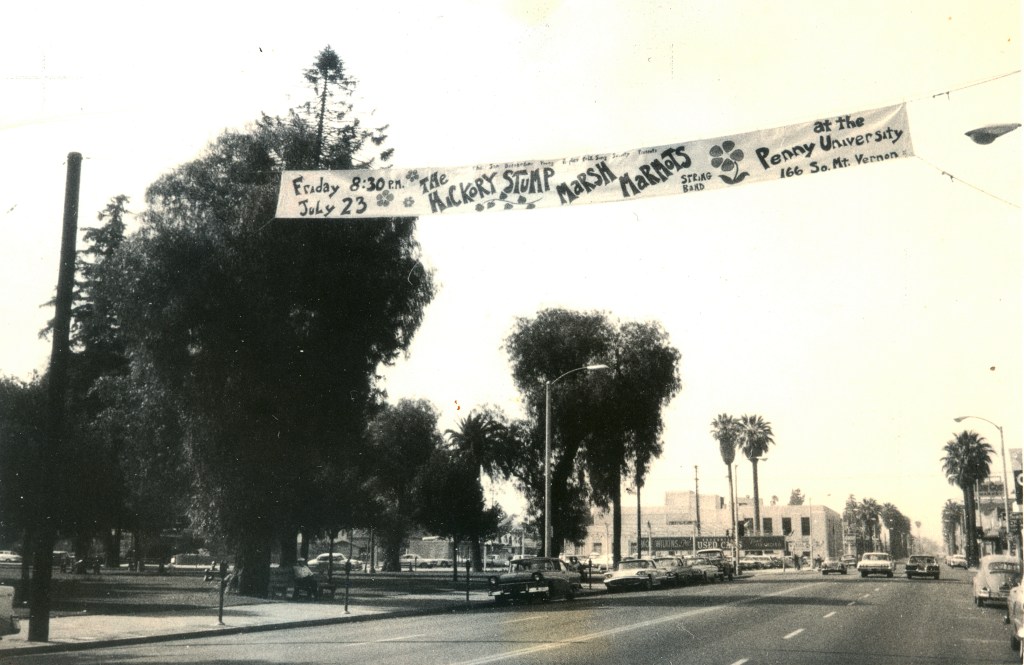
(Marmots banner across E. Street in San Bernardino)
(Photo: June Fraley)
I first set eyes on David Dickey in 1971 at a folk music coffee house in San Bernardino, calling itself The Penny University. My high school friends and I had discovered this establishment naively as a place to escape our parents, roll our own tailor-made cigarettes, and embrace the coffee, a truck stop worthy elixir with the aftertaste of nails, that went for a centavo. It was a hoot-night, which is an amateur-night where one act after another shouldered their way onto a rickety plywood stage, bellying up to some Army Surplus microphones, and had their way at some socialist inspired zither musing. Then serendipitously Dickey’s five-piece ensemble plowed through the door, as from a dead serious clown car, like if Samual Beckett were the governor of Oklahoma. The evening was in the pliant throes of summer, near a hundred at night, contradicting the musicians who were wearing wool suits and shellac black cowboy hats, looking the spitting image of farm-ready, and calling themselves The Hickory Stump Marsh Marmots.
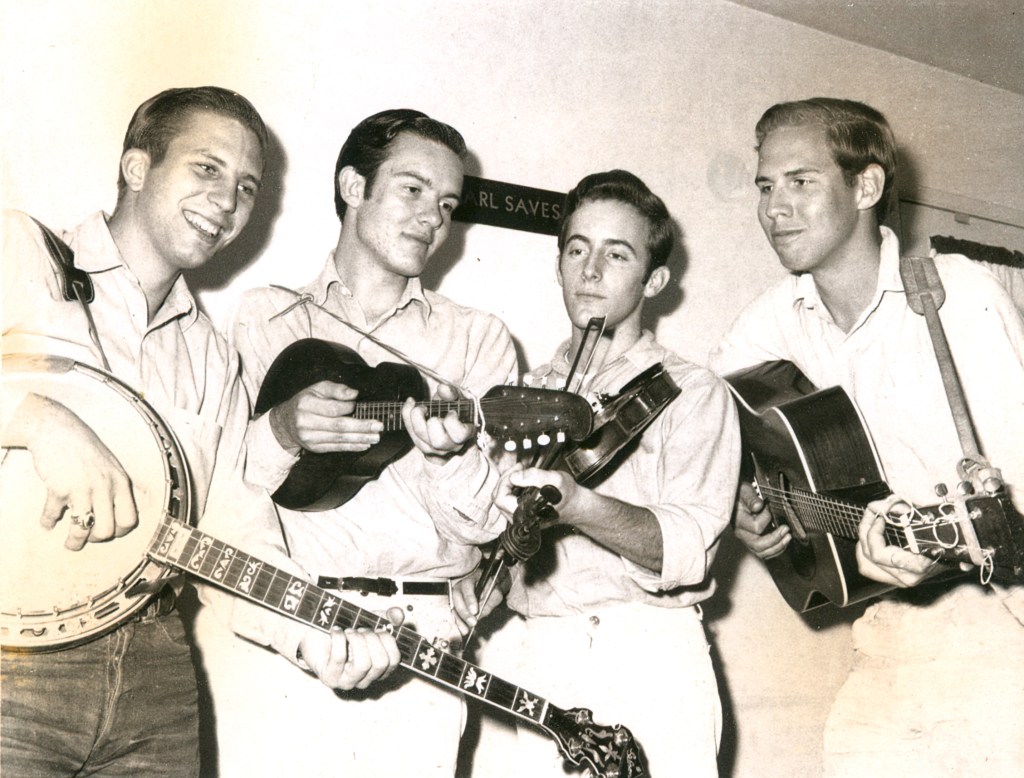
(photo: June Frailey) L-R Jim Hawkins, Dickey, John Seeger, Bob Gregory
David Dickey approached my table, threw down a mandolin case and unlatched its lid, which exposed to my face his nickname, “The Colonel”. It seemed just as profound then as it does today. Like the lessons he would teach me in the then-unbeknownst future, everything was self-explanatory and interlocked with symbolism. I never could have dreamed that in five years’ time I would be playing the fiddle with him in a bluegrass group called Lost Highway.
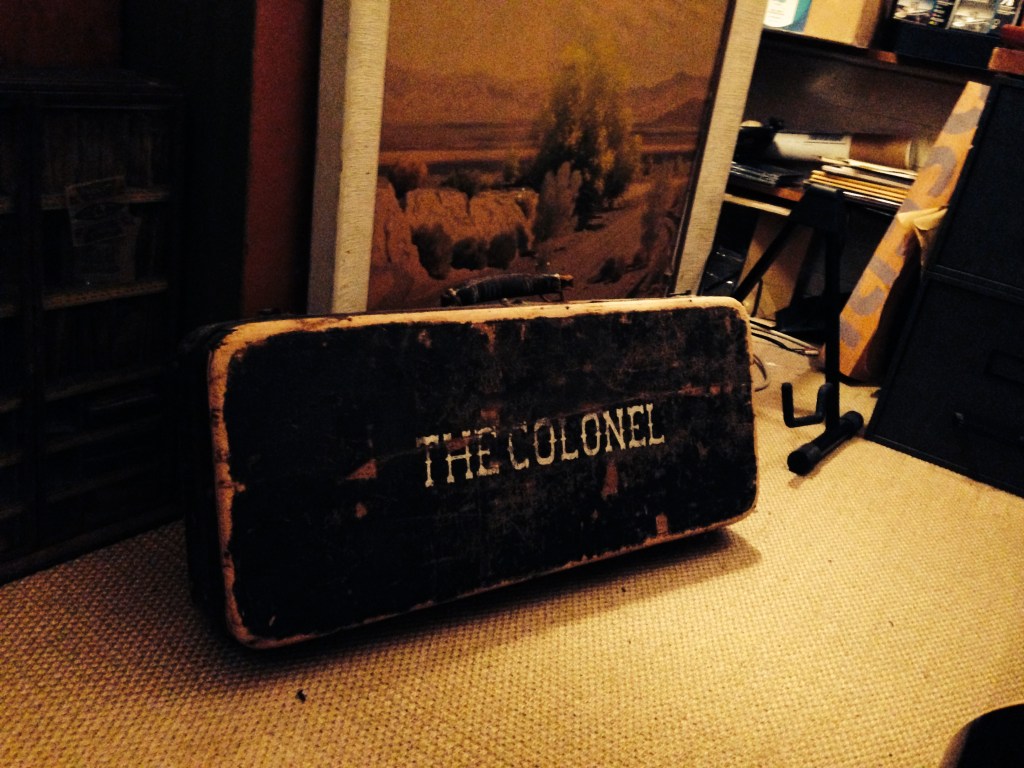
(Photo: The Brayer Archives) The famed mandolin case.
Backtracking a smidgen, I now recall one of my favorite Dickey stories, which also includes that famous mandolin case. After being tagged with the nickname “The Colonel”, he decided to paint it on the roof of his instrument case in white lettering. As he worked to get it done, he had gotten as far as C-O-L-O-N when the front doorbell rang. He went to deal with the intrusion, and when he returned, his mother was distraught and crying. She blurted out, “David!! You can’t call yourself The Colon!!”.

(Photo: William Purcell) Lost Highway, Norco CA
Walden Dahl and I had started the group Lost Highway in 1994, but it wasn’t really a cohesive group until we convinced Dickey to join. He said he would agree under one condition, that his friend and running mate, Lauren Seapy, could also join. That turned out to be a no-brainer since she was the best musician in the group, who played the banjo like Ralph Stanley from the Clinch Mountains, and looked like the Sun Raisin Maid embodied on the raisin box. We believed that we had finally found the real thing in Dickey. And indeed, we had. We got real serious really quick. Dickey quit his teaching position at Crafton Hills College; we bought a two-toned red and white 1950’s Flxble bus, and David decked us out in 1940’s thrift store armor. In Open Road Stetson hats and dusty wingtips, we set out to shadow the likes of our jazz-infused stringband heroes, Bill Monroe and the Bluegrass boys, Flatt and Scruggs, and the darkly sonic talons of the Stanley Brothers. Our look was really authentic, although Walden and I looked a little like scarecrows at harvest time in our suits, while Dickey looked like, as I said, “the real deal”, bursting with self-made charisma, a million bucks, tax-free.
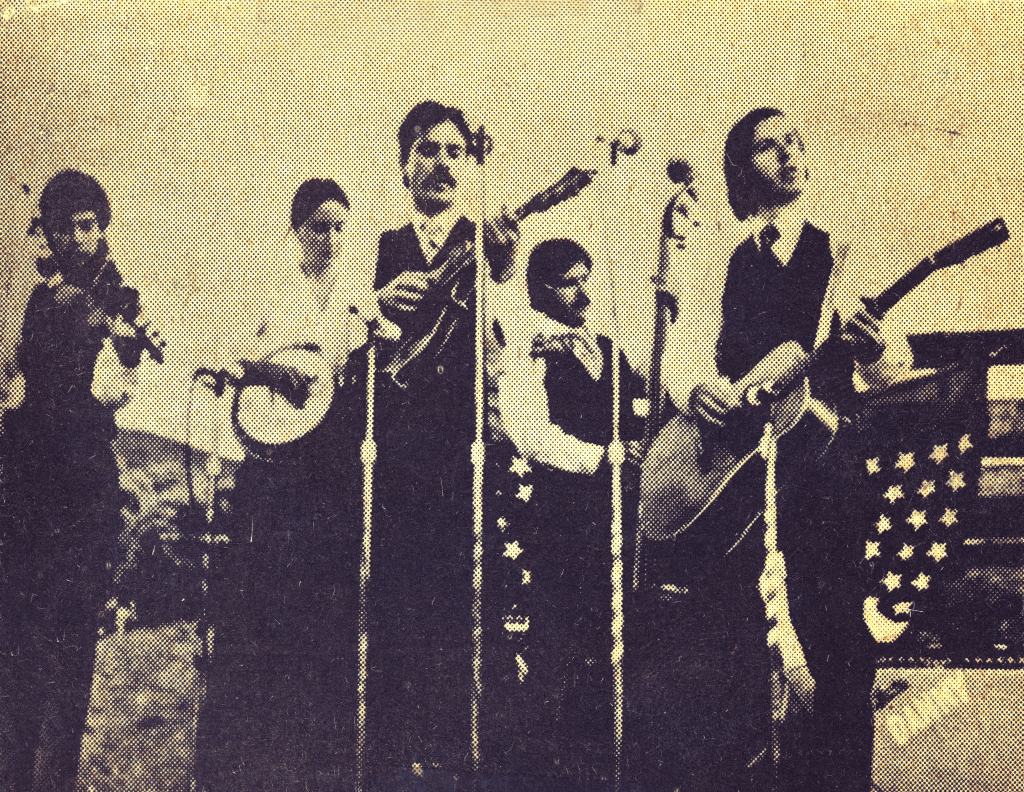
(Newspaper: L-R Pat Brayer, Lauren Seapy, Walden Dahl, Ed Contrell, David Dickey II) Calico Ghost Town
David played in many bluegrass bands before and after Lost Highway. Besides the aforementioned Hickory Stump Marsh Marmots, there were The Slover Mountain Boys, The String Bandits, The Solid State Boys, and The Dry River Drifters.

(Photo: William Purcell) L-R Dickey, Purcell, Bobby Fraley, Chris Gray Fontana CA
Today, reeling in the years, I am known more for songwriting than anything else, and that is due to David’s strong encouragement in getting us to write our own songs, which he was already well into doing himself. Some of the venues we played in those days were Dick Tyner’s Golden West Bluegrass Festival, The Grass Valley Bluegrass Festival, and a long-standing residency at The Penny University in San Bernardino. We played regularly at a joint called Leone’s in Idyllwild, which was owned by Tommy Duncan of Bob Wills and the Texas Playboys fame. Frank Sinatra would sometimes come to hear us play as he owned a bunch of ranch property in nearby Anza.
Although leaving a legacy as a master musician of the highest order of originality, and serving as an inspiring mentor, this is only one aspect of many of his features, dear father, loving son, husband, public school teacher, bus driver. David Dickey had the key to life, that being the power to let you know that he believed in you, and although you couldn’t exactly see what he saw, you still couldn’t help but believe him. Towards the end, he was on dialysis for fifteen years due to kidney failure. We watched him suffer through it, and we knew he was doing it for us, so that we might have fifteen extra years in his presence. The ultimate gift.

Classic Lost Highway 1977 with Jeff Ruff (Cody Bryant) on bass.
The Colonel was married twice, and both times to Fontana women. You’d better believe that, in time, we laughed about that, my family buying an egg ranch there in 1958, and him raising Tennessee Walking Horses in the Jurupa-Fonta foothills. With his second wife, Peggy, he shared the gift of a son, David Dickey III, and at the time of that birth, David II immediately shifted all his focus onto fatherly matters, an attention that never waned for a second, all the way up to his last days. It seemed impossible to even imagine a more dedicated father-son duo, Little Dave taking up the mandolin mantle, like an Olympic torch, and surpassing all of us in virtuosity in no time flat. Full circle, I think they call it.
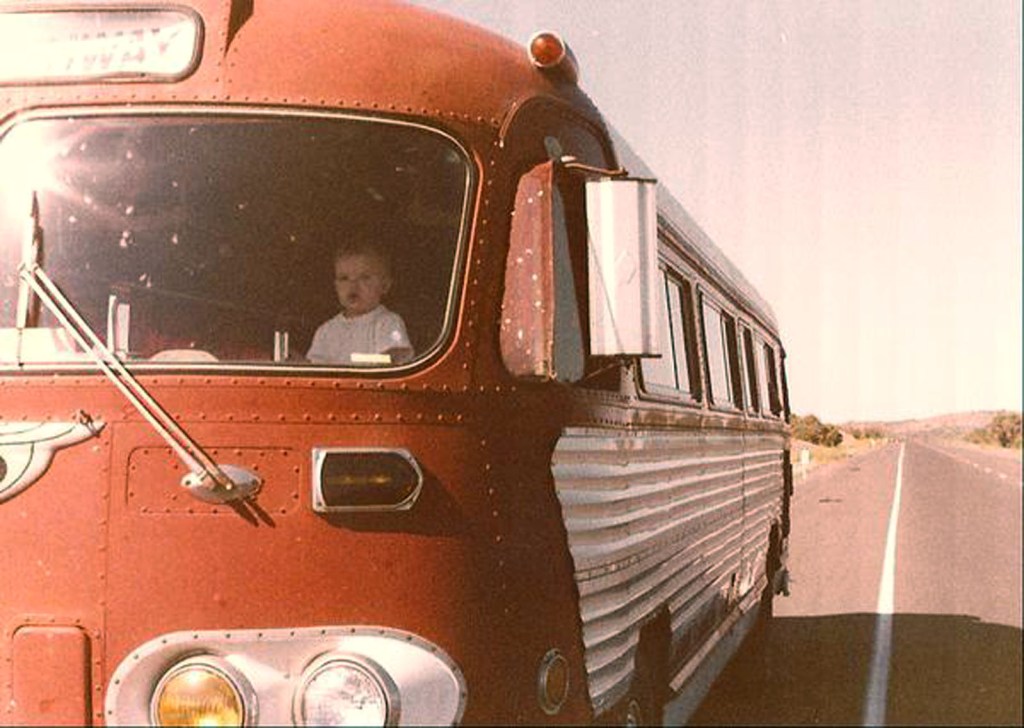
The Lost Highway bus with David Dickey the 3rd at the helm.
During the dialysis years, we had the bright idea to get together every other Thursday for our version of what we coined as The Wrongtario Film Festival. Always shooting for a double bill, like in the old days when one went to a cinema house or drive-in theatre. Being drastically hard of hearing required subtitles, and we had come upon a way to be together for about four hours without having to scream at each other. Between films, I would, somehow turning into a Jewish mother, serve up things like tuna fish sandwiches and Schweppes ginger ale. After that, we would comb the neighborhood. We must have been a sight, screaming at each other in an attempt to get his money’s worth out of that Costco hearing aid, a pair of bantam-weight geezers, two pterodactyls screaming as if to reach the back row of Shakespeare’s Old Globe Theatre. In between large but comfortable chunks of silence I grew to realize that like a guru, he would often not talk unless you asked him a question, and then stories would pour out of him, about his parents controversial marriage, both on military leave, about his mother and her psychic, or about a number of beautiful vaporous women that had come, changed the sheets, and gone to flutter into pleasant memory.

(Photo: June Frailey)
When we said our last goodbye, he shyly awarded me his cherished framed photograph of Lauren Bacall signed “For David, With my Best”. You see, he knew how to give a gift, being one himself.
The day after our last goodbye, I texted him. In the note I told him, and I quote, “my daughter and I were talking about some of the great qualities you have about you. One is your ability to see someone for what they are, their true nature. You were able to see my wife, not just as my wife, and our daughter, not just as our daughter, but to see them as equally important, as their true selves. That, as a seer, is a keen gift, and you backed it up with a rotatingly glochanspeal of box chocolates. I know we said our heartfelt goodbyes yesterday, but I couldn’t help but pop back in, like that guy who tries to leave, but has to come back in cuz he forgot his keys, phone, or Igloo ice chest.”
“I will always remember all the hay bale stages we performed on, and your strong generosity of spirit. I have a hard time imagining what the world will look like without you in it. I’m sure it will be similar in ways, only a whole lot dumber. But that’s our problem, not yours. I just hope you can rest in all the joy that you have genuinely brought to others.
Our best to the best / The Brayers of Wrongtario

L-R Bobcat Fraley, Dickey, Jim Hawkins, Bob Gregory, Roland Hawkins
It is said that it is impossible to nutshell a man’s life without sooner or later being fanned by the earthbound angels of paradox. David Dickey was of dignified character, yet he didn’t and wouldn’t own a computer, no cable TV, listening to the Dodger games on the radio, a lot of the wind taken from its sails when Vin Skully passed away in 2002. I knew he had a DVD player on account of, when exchanging Xmas presents one year, opened in unison, identical box sets of the entire series of The Rockford Files. It contained all 122 episodes of the 1970s gumshoe, played by James Garner, calling itself The Rockford Files. Dickey also gifted me the vintage pinstripe suit that I got married in beside a cotton field in 1999, along with a satin necktie, a thrift store find, designed by surrealist Salvador Dali.

Brayer and Dickey at the Chris Darrow Memorial 2020 (Photo: Iggy Henderson)
I can’t help but always remember, flipping through my rolodex of spontaneous memory, his sapphire blue sunglasses, the regal pirate bent of his mutton chop sideburns, his hair turning an awarding silver, his collection of UFO conspiracy books, our shared affection for the pulp fiction poetics of Raymond Chandler, James M. Cain, and Cornell Woolrich, and everything from the saturated shadows of Bogart and Bacall, from Conway Twitty and the shell of his honky-tonk pompadour, to depression era Bo weevil field recordings scratching their way from the jaws of the victrola, not to mention his encyclopedic grasp of the egghead science of mandolin luthery, according to the greatest sound pioneer of them all, Lloyd Allayre Loar (1886-1943), which led to his coaching the Gibson custom shop in their making of an F-5 for him to his own enlightened specifications.
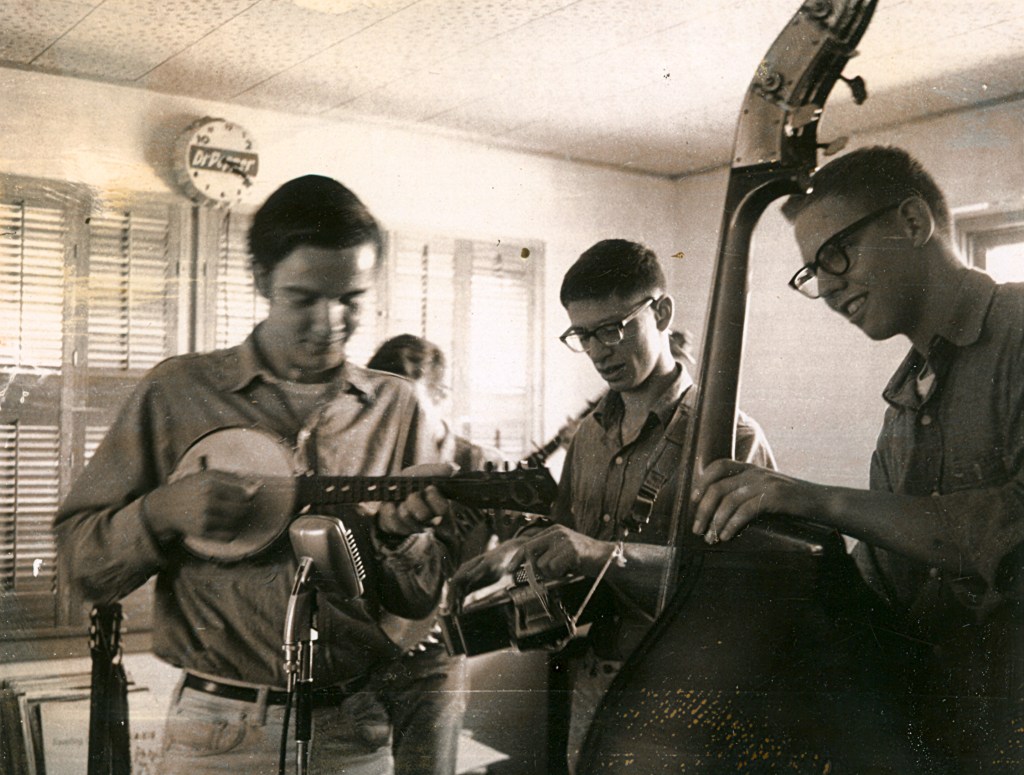
(Photo: June Frailey)
One thing I thought was amazing, besides never having had a single argument with him in the span of our fifty-year friendship, was how, on our biweekly walks and chats through our sun-stained suburbia, was how we never once spoke of religion nor politics. We never set that up as a standing credo; it was, in looking back, just that in the realm of our bond, it just remained organically superfluous.

L-R Dickey, Bob Fraley, banjo unknown, Chris Boutwell on guitar.
And finally in closing I will include a poem to be read, maybe mythologically, from out front of the condemned hull of a tavern called The Jet Lounge in rural San Bernardino, a stone’s throw from a trailer court, like the one David was once hole up in from his early days as a school bus driver, butting up against a weed bedazzled Air Force scrapyard of which he shared a fenceline with. The Mayor of San Bernardino steps up to the microphone and, through the glass broken feedback, from a plank stage, reads aloud from a cocktail napkin:
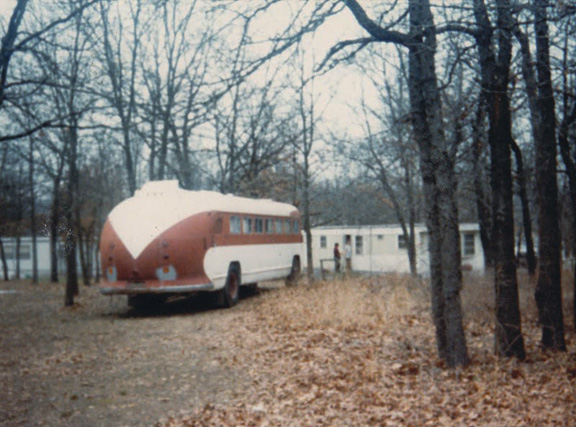
The Bluegrass Turns to Black (For David Dickey II)
The bluegrass turns to black tonight.
To a kite, a dreamscape wants a tether
Not the ink darkness of sorrow, but the raven shadows of slumber.
Until instruments become living lumber, merely left behind
The white light, being the energy of life at best
Until the eyes that closed in rest, become the just darkness of being
Where there be no such given things.
despite a sky of liquid wings
As anything such as evil purportedly does
to the quotation shape of gloves
To those like him that serve their time
whose sunlit feathers begin a climb.
A coal shadow around every bend
begin a source, it never ends
Poa pratensis, yes, you read it right
where light is life and life is light
The darkness combs as a product of night
yet paints the bluegrass black tonight
Yet paints the bluegrass black

David’s father in WWI garb.
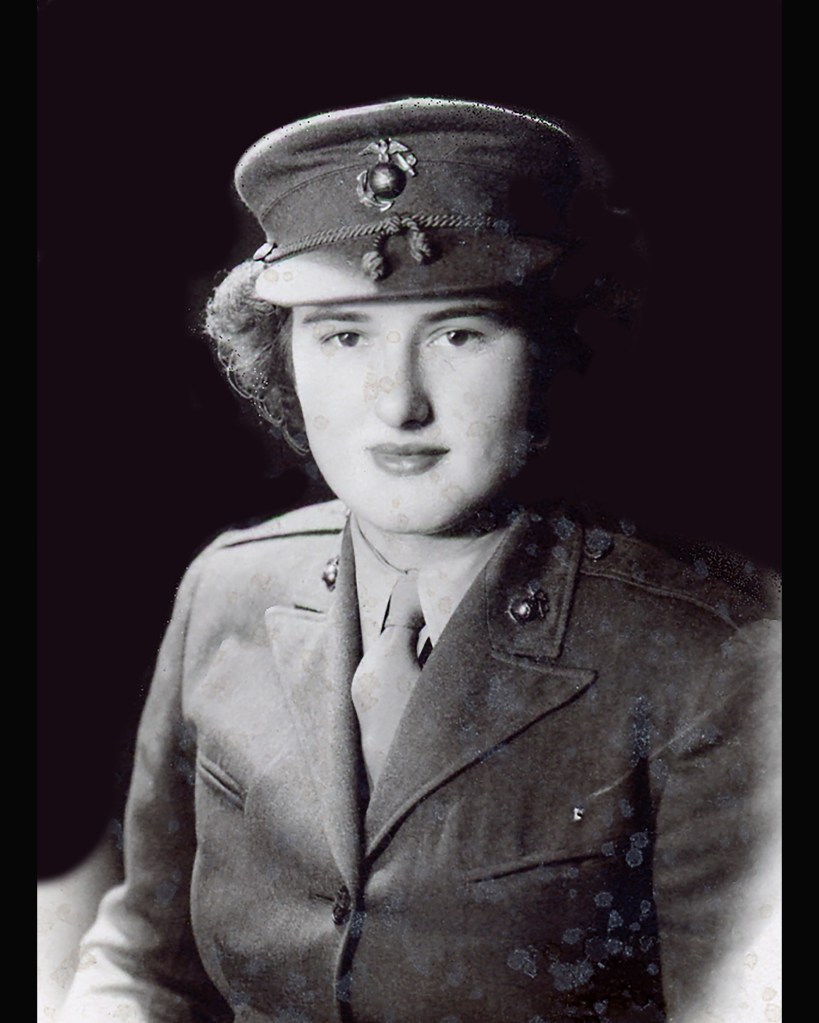
David’s Mother.

